It's the FuelEU Pool Optimiser — a free, auditable tool that takes a whole fleet and finds the lowest-cost way to meet FuelEU Maritime: pooling surpluses against deficits, switching fuel where it pays, and paying the penalty only on what's left. Every regulatory figure is traced to Regulation (EU) 2023/1805. The tool does the calculation. Our advisory turns it into decisions.
Plenty of free tools work out one ship's FuelEU penalty. That arithmetic is the easy part. The expensive question for an operator with a fleet is different: which ship's surplus should cover which ship's deficit, where is a fuel switch actually worth its cost, and what should simply be paid as a fine — to make the whole fleet's total cost as low as it can legally go.
With more than a couple of ships, that answer is not obvious by eye. It's a constrained optimisation problem. We built an open engine that solves it, verified its every regulatory constant line by line against the primary regulation text, and published it. Releasing it openly is how we show the numbers hold up — not because we say so, but because the code, the tests, and the verification trail are all public.
Automated tests pinning the regulation maths and the optimiser's decisions to hand-worked and published values, so results can't silently drift.
Of regulatory constants — limit, reduction trajectory, penalty rate, fuel factors — checked line by line against Regulation (EU) 2023/1805 and the European Commission guidance, with a published audit trail.
A fully open licence. Free to read, run, audit, and build on — with documented methodology behind every formula.
Enter your fleet in the browser — or upload a CSV — and the optimiser weighs three levers for every ship at once, then returns the lowest-cost combination against the do-nothing baseline:
Nets surpluses against deficits across a single company's fleet, the way Article 21 allows, keeping the pool total non-negative. The engine decides which surplus best covers which deficit.
Where a cleaner fuel is cheaper per gram abated than the penalty, the optimiser switches it; where it isn't, it leaves the fine. The Annex IV penalty and the consecutive-year multiplier are implemented straight from the regulation.
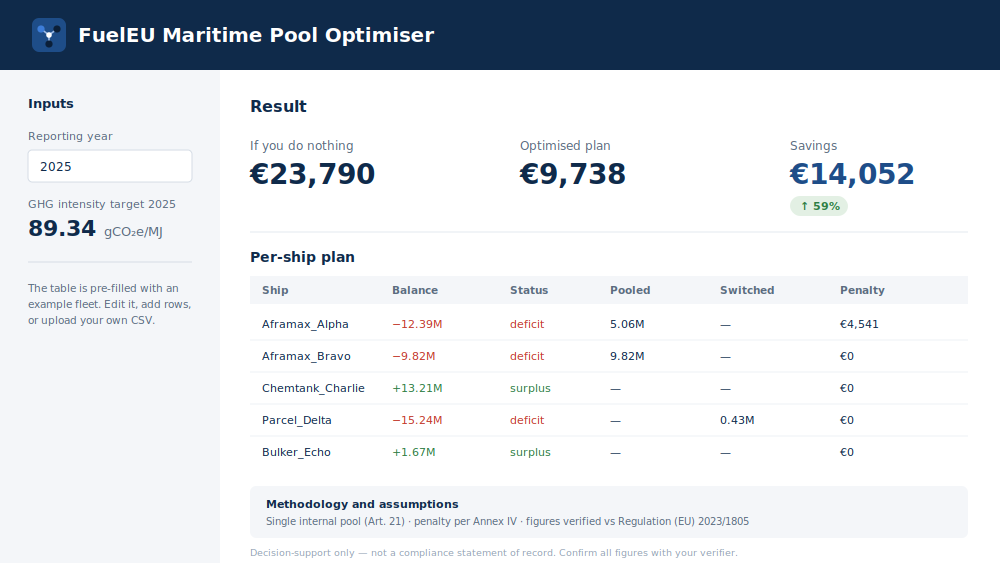
The live dashboard optimising a sample fleet. Edit the fleet table in the browser or upload your own CSV — no installation required.
The optimiser is deliberately a calculation engine, not a consultant. It will tell you that pooling your fleet internally saves a six-figure sum, or that one vessel is cheaper to switch than to pool. What it does not do is negotiate the pooling agreements, weigh the counterparty risk, or fold the result into your wider EU ETS and chartering strategy. That is where a Navallogic engagement begins.
The FuelEU Pool Optimiser produces estimates for planning and insight. It is decision-support, not a verified Statement of Compliance — those are issued by verifiers and administering States against verified data. The tool is built to be correct against the published formulae and is offered as a decision-support aid, not a regulatory authority. Banking, borrowing and cross-company pooling are out of scope in this version and documented as such.
Try the optimiser on your own fleet, then talk to us about turning the output into negotiated pooling agreements and a multi-year compliance strategy. The first conversation is a scoping discussion with no obligation.