Open Source · Built by Navallogic

We open-sourced the analytics engine behind our performance work

It's called NoonKit — a free, auditable tool that reads a vessel's noon reports and surfaces its hull-fouling signal and IMO CII rating, with every formula traced to the IMO resolution it comes from. The tool does the calculation. Our advisory turns it into decisions.

Why we built it

Rigorous analytics shouldn't be a black box

Maritime performance and compliance tools are almost all closed, proprietary, and priced for major operators. We took the opposite view. The core calculations behind a vessel performance audit — the speed–consumption baseline, the fouling trend, the CII rating — should be transparent enough that anyone can check them.

So we built that core as an open-source engine, verified it line by line against the primary IMO resolution documents, and published it. It is the same analytical foundation our advisory work is built on. Releasing it openly is how we show our numbers hold up to scrutiny — not because we say so, but because the code and the tests are public.

How we know it's correct

Verified against the regulation, not asserted

32

Automated tests, including the IMO's own published worked example, pinning every result to the regulation so the math can't silently drift.

2

Coefficient errors caught and corrected by checking line by line against the official IMO MEPC resolution PDFs.

MIT

A fully open licence. Free to read, run, audit, and build on — with documented methodology behind every formula.

What the tool does

Two answers from data your vessels already produce

No new hardware, no sensors — just the daily noon report. Upload a CSV, where common column names are mapped automatically, and NoonKit returns:

01

Hull-fouling signal

Fits a clean-hull speed–consumption baseline from good-weather days, then measures how fast consumption is drifting above it over time — the early fingerprint of fouling, before it shows up as a fuel bill.

02

IMO CII rating

Computes the attained and required Carbon Intensity Indicator and the A–E rating, implemented straight from the MEPC resolutions, with a full audit trail and honest treatment of the not-yet-adopted post-2026 factors.
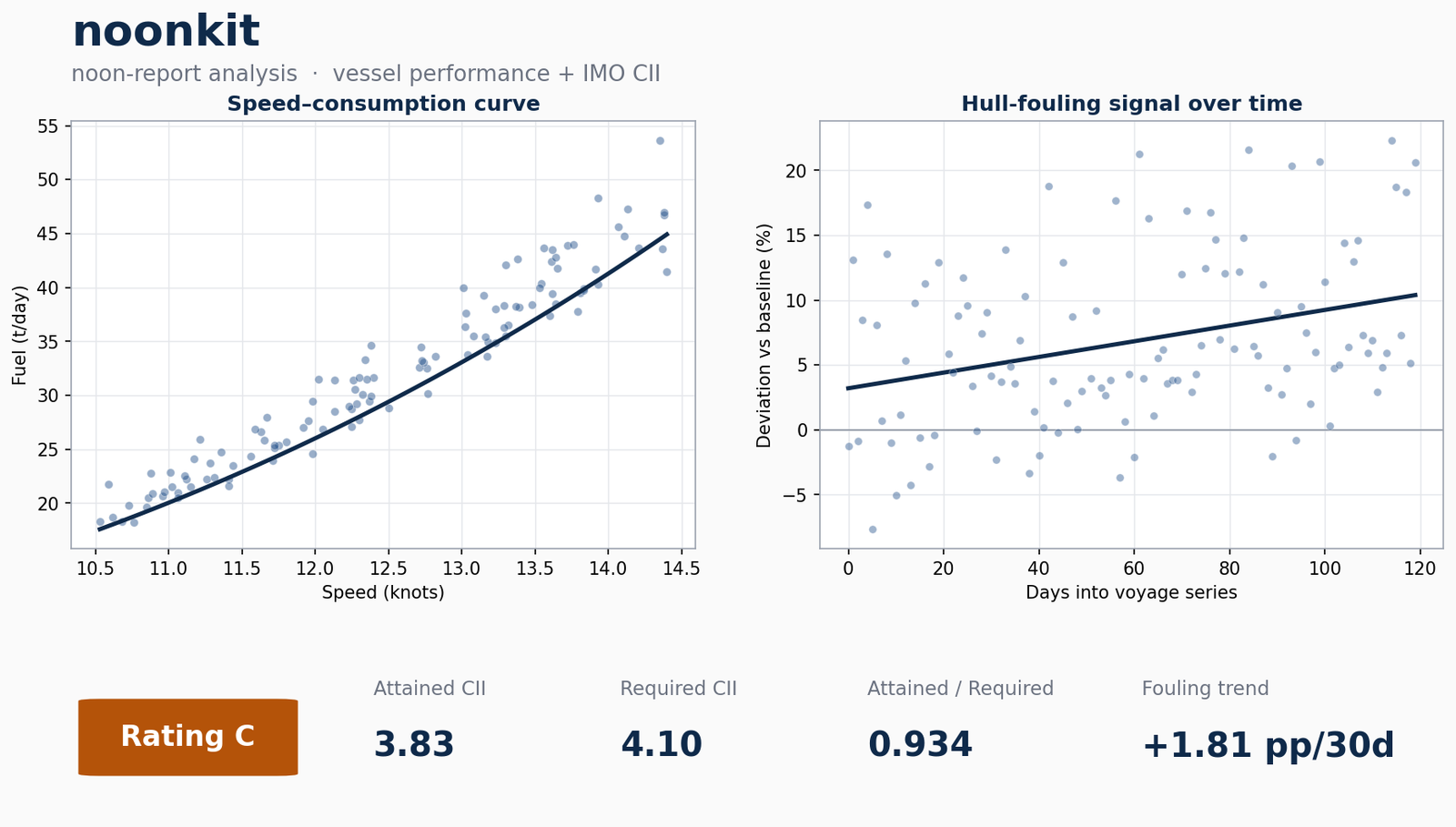
noonkit dashboard showing a speed-consumption curve, a fouling-signal trend over time, and an IMO CII rating of C

The live NoonKit dashboard analysing a sample voyage series. Run it yourself with the built-in demo data — no installation required.

Tool and advisory

The tool gives you the number. We tell you what to do about it

NoonKit is deliberately a calculation engine, not a consultant. It will tell you that consumption is drifting nearly two percent a month above baseline, or that a vessel is heading for a D rating. What it does not do is decide what that means for your dry-dock schedule, your charter parties, or your regulatory exposure. That is where a Navallogic engagement begins.

The free tool does
  • Calculates the speed–consumption baseline and fouling trend
  • Computes the attained and required CII and the A–E rating
  • Flags suspect noon-report data instead of hiding it
  • Shows its full working, traceable to IMO sources
The advisory adds
  • Interpretation — which findings matter, and why, ranked
  • Financial quantification of fuel and EU ETS / FuelEU exposure
  • Action — in-water cleaning, dry-dock timing, CII trajectory correction
  • Integration with PMS, EU ETS and FuelEU strategy as one picture

NoonKit produces estimates for planning and insight. It is not a verified Statement of Compliance — those are issued by Administrations and Recognized Organisations against verified data. The tool is built to be correct against the published formulae and is offered as a decision-support aid, not a regulatory authority.

See what the engine reveals about your fleet

Try the tool on your own noon reports, then talk to us about turning the output into ranked, costed, fleet-wide recommendations. The first conversation is a scoping discussion with no obligation.